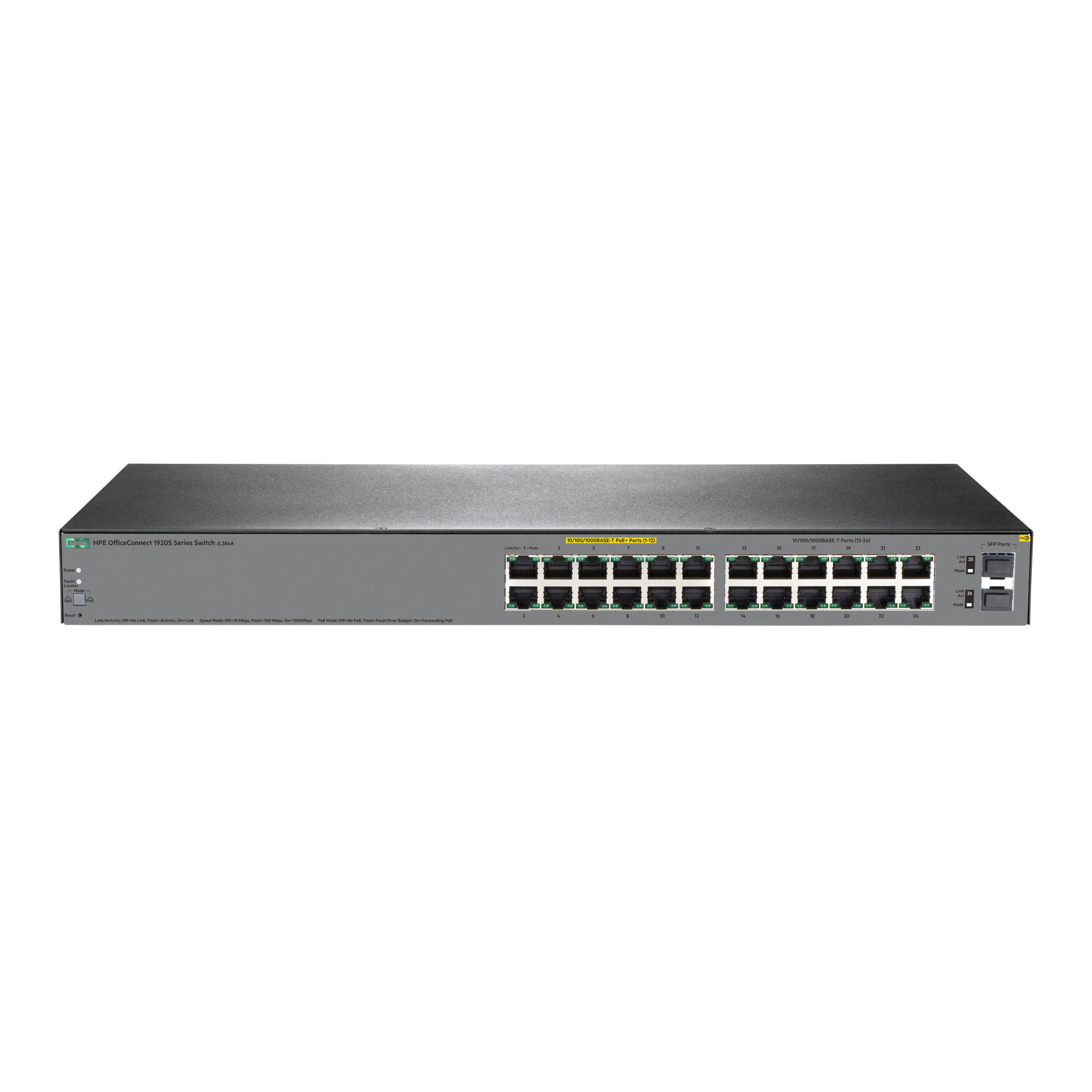
Description
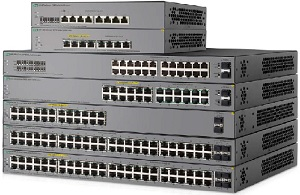
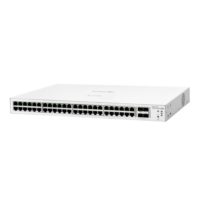
The HPE OfficeConnect 1920S Switch Series consists of advanced smart-managed fixed-configuration Gigabit switches designed for small businesses in an easy-to-administer solution.
The series consists of seven switches including 8- 24- and 48-port Gigabit Ethernet switches and 8-, 24- and 48-port PoE+ models of which half the ports are POE+ capable. An additional 24-port PoE+ model is available that provides PoE+ on all 24ports. All ports provide non-blocking Gigabit per performance. Some models include SFP ports for fiber connectivity and the 8-, 24- and 48-port non PoE+ models are fanless, making them ideal for office deployments. All HPE OfficeConnect 1920S Switches support flexible installation options, including mounting on wall, under table, or on desktop. The 8-port Gigabit Ethernet model can be powered by an upstream Power over Ethernet switch for environments where no lline power is available.
The series is part of the OfficeConnect portfolio of Hewlett Packard Enterprise small business networking products. These switches provide a great value, and includes features to satisfy even the most advanced small business networks. Customizable features include basic Layer 2 features like VLANs and link aggregation, as well as advanced features such as Layer 3 static routing, IPv4 and IPv6 Host mode, ACLs, and Spanning Tree Protocols. HPE OfficeConnect 1920S Switch Series includes a Limited Lifetime Warranty.
Features and benefits
Management
- Simple Web management
Allows for easy management of the switch—even by nontechnical users—through an intuitive Web GUI; supports HTTP and HTTP Secure (HTTPS) - SNMPv1, v2c, and v3
Facilitate management of the switch, as the device can be discovered and monitored from an SNMP management station - Complete session logging
Provides detailed information for problem identification and resolution - Port mirroring
Enables traffic on a port or VLAN to be simultaneously sent to a network analyzer for monitoring - Dual flash images
Provide independent primary and secondary operating system files for backup while upgrading - Network Time Protocol (NTP)
Synchronizes timekeeping among distributed time servers; keeps timekeeping consistent among all clock-dependent devices within the network so that the devices can provide diverse applications based on the consistent time - Manual network time configuration
Manually set the date and time on the switch in the absence of an NTP server - Default DHCP client mode
Allows the switch to be directly connected to a network, enabling plug-and-play operation; in absence of a DHCP server on the network, the switch falls back to the static address 192.168.1.1 - FTP and TFTP
Provides different mechanisms for configuration updates; FTP allows bidirectional transfers over a TCP/IP network; trivial FTP (TFTP) is a simpler method using user Datagram Protocol (UDP) - Remote monitoring (RMON)
Remote monitoring (RMON) provides advanced monitoring and reporting capabilities for statistics, history, alarms and events. RMON data is retrieved from the switch through a network management platform over SNMP. -
Quality of Service (QoS)
- Traffic prioritization
Provides time-sensitive packets (like VoIP and video) with priority over other traffic based on DSCP or IEEE 802.1p classification; packets are mapped to six hardware queues for more effective throughput - IEEE 802.1p/Q VLAN tagging
Delivers data to devices based on the priority and type of traffic; supports IEEE 802.1Q - Advanced classifier based QoS
Classifies traffic using multiple match criteria based on Layer 2, 3, and 4 information. - Packet storm protection
Protects against unknown unicast, broadcast and multicast storms with user-defined thresholds - Rate limiting
Sets per-port ingress enforced maximums or percent minimum bandwidth per queue - Class of Service (CoS)
Sets the IEEE 802.1p priority tag based on IP address, IP Type of Service (ToS), Layer 3 protocol, TCP/UDP port number or source port - Powerful QoS feature
Supports the following congestion actions: strict priority queuing (SP) or weighted round robin (WRR) queuing. SP and WRR queuing can be configured on individual switch ports.
Connectivity
- IPv6 host
Enables switches to be managed and deployed at the IPv6 network’s edge - IEEE 802.3X
Flow Control Provides a flow throttling mechanism propagated through the network to prevent packet loss at a congested node - IEEE 802.3at Power over Ethernet (PoE+)
Provides up to 30 W per port, which allows support of the latest PoE+ capable devices such as Video IP phones, wireless access points, and advanced pan/tilt/zoom security cameras, as well as any 15.4 W IEEE 802.3af-compliant end device; mitigates the cost of additional electrical cabling and circuits that would otherwise be necessary in IP phone and WLAN deployments - PoE+ port availability
Ports 1–4 are PoE/PoE+ capable on the HPE OfficeConnect 1920S 8G PPoE+ 65W switch; ports 1–12 are PoE/PoE+ capable on the HPE OfficeConnect 1920S 24G 2SFP PPoE+ 185W switch; all ports provide PoE/PoE+ on the HPE OfficeConnect 1920S 24G 2SFP PoE+ 370W switch; ports 1–24 are PoE/PoE+ capable on the HPE OfficeConnect 1920S 48G 4SFP PPoE+ 370W switch - Auto-PoE power configuration
The switch automatically assigns the required power to a port for a PD device based on Link Layer Discovery Protocol (LLDP). Optionally, the switch permits manual, per port, PoE power configuration - PoE shut down mode
A PoE scheduler provides the ability to define the hours of PoE power being supplied to a group of switch ports based on a 24-hour day. The scheduler enables the flexibility to select individual days of a week as well as reoccurrence on a weekly basis with a start and end date. - PoE power allocation
Support multiple methods (automatic, IEEE 802.3af class, LLDP-MED, or user-specified) to allocate PoE power for more efficient energy savings - SPF ports for fiber connectivity
Provides fiber connections for uplinks and other connections across longer distances than copper cabling can support; SFP ports are in addition to available copper Ethernet ports, providing a higher total number of available ports. Two SFP ports available on 24 and four SFP ports on 48 port models - Loop protection
If the switch detects a loop, it disables the source port from forwarding data packets originating from the switch to avoid broadcast storms - Auto MDI/MDI-X
Adjusts automatically for straight-through or crossover cables on all 10/100/1000 ports - Energy Efficient Ethernet (EEE)
Compliant with IEEE 802.3az standard requirements to save energy during periods of low data activity - Auto-port shut down
The switch saves power by automatically shutting down power to inactive ports. Power is restored on a port upon link detection - Energy savings status
The switch provides an estimated cumulative energy savings due to green Ethernet features being enabled - Energy-efficient cooling
Includes variable speed fans operating only at the speed necessary to maintain operating temperature to reduce excess noise and power consumption by the switch
Security
- Access Control Lists (ACLs)
Enables network traffic filtering by creating an ACL, add rules and match criteria to an ACL, and apply the ACL to permit or deny on one or more interfaces or a VLAN. Up to 50 inbound entries may be configured based on IPv4 source and destination IP and MAC address, Layer 4 ports and protocol type of the IPv4 packet. - RADIUS
The switch support RADIUS authentication and configuration of up to 8 RADIUS servers - RADIUS Accounting
A robust set of attributes and statistics are available for collecting information from the switch - IEEE 802.1X access control
Authentication of network users on a per port basis prior to permitting network access. Port VLAN includes RADIUS VLAN assignment, dynamic VLAN creation, guest VLAN or into an unauthenticated VLAN. - Switch 802.1X supplicant
Enables the switch to authenticate itself to a RADIUS server - Port isolation
Ports in a port isolation group are restricted from forwarding Layer 2 traffic between ports in that group; provides data privacy and security - Automatic denial-of-service protection
Monitors for malicious attacks and protects the network by blocking the attacks - Management password
Provides security so that only authorized access to the Web browser interface is allowed - Secure Sockets Layer (SSL)
Encrypts all HTTP traffic, secure access to the browser-based management of the switch
Performance
- Half-and full-duplex auto-negotiating capability on every port
doubles the throughput of every port - Selectable queue configurations
Allows for increased performance by selecting the number of queues and associated memory buffering that best meet the requirements of the network applications - IGMP snooping
Improves network performance through multicast filtering, instead of flooding traffic on all ports - SFP fiber uplinks
Provides greater distance connectivity using Gigabit fiber uplinks
Layer 2 switching
- Spanning Tree Protocol (STP)
Supports standard IEEE 802.1D STP, IEEE 802.1w Rapid Spanning Tree Protocol (RSTP) for faster convergence, and IEEE 802.1s Multiple Spanning Tree Protocol (MSTP) - BPDU filtering
Drops BPDU packets when STP is enabled globally but disabled on a specific port - Jumbo frame support
Supports up to 9216 bytes frame size to improve the performance of large data transfers - VLAN support and tagging
Support for IEEE 802.1Q; 256 VLANs with a VLAN ID range of 2-4093
Layer 3 services
- Address Resolution Protocol (ARP)
Displays the MAC address of another IP host in the same subnet; supports static ARPs; proxy ARP allows normal ARP operation between subnets or when subnets are separated by a Layer 2 network - DHCP relay
Simplifies management of DHCP addresses in networks with multiple subnets
Layer 3 routing
- Static IPv4 routing
Provides basic routing supporting up to 32 static routes to allow manual routing configuration - Link aggregation
Groups together multiple ports up to a maximum of eight ports per trunk either automatically using Link Aggregation Control Protocol (LACP), or manually, to form an ultra-high-bandwidth connection to the network backbone; help prevent traffic bottlenecks. The 8 port models support 4 trunks, 16 and 24 port models support 8 trunks, 48 port models support 16 trunks.
Convergence
- LLDP-MED (Media Endpoint Discovery)
Defines a standard extension of LLDP that stores values for parameters such as QoS and VLAN to configure network devices such as IP phones automatically - Auto voice VLAN
Recognizes IP phones and automatically assigns voice traffic to dedicated VLAN for IP phones
Warranty and support
- Limited Lifetime Warranty
- See http://www.hpe.com/officeconnect/support for warranty and support information included with your product purchase.
| I/O ports and slots | 12 RJ-45 autosensing 10/100/1000 PoE+ ports; Duplex: 10BASE-T/100BASE-TX: half or full; 1000BASE-T: full only | |
| 12 RJ-45 autosensing 10/100/1000 ports (IEEE 802.3 Type 10BASE-T, IEEE 802.3u Type 100BASE-TX, IEEE 802.3ab Type 1000BASE-T); Duplex: 10BASE-T/100BASE-TX: half or full; 1000BASE-T: full only | ||
| 2 SFP 100/1000 Mbps ports (IEEE 802.3z Type 1000BASE-X, IEEE 802.3u Type 100BASE-FX) | ||
| Physical characteristics | Dimensions | 17.42(w) x 9.69(d) x 1.73(h) in Weight (44.25 x 24.61 x 4.39 cm) (1U height) |
| Weight | 7.3 lb (3.31 kg) | |
| Memory and processor | ARM Cortex-A9 @ 400 MHz, 256 MB SDRAM, 64 MB flash; packet buffer: 1.5 MB | |
| Performance | 100 Mb Latency | < 7.0 µs |
| 1000 Mb Latency | < 2.0 µs | |
| Throughput | 38.6 Mpps | |
| Routing/Switching capacity | 52 Gbps | |
| Routing table size | 32 entries | |
| MAC address table size | 8,000 entries | |
| Reliability | MTBF (years) | 64.52 |
| Environment | Operating temperature | 32°F to 104°F (0°C to 40°C) |
| Operating relative humidity | 15% to 95% @ 104°F (40°C) | |
| Storage temperature | -40°F to 158°F (-40°C to 70°C) | |
| Storage relative humidity | 15% to 95% @ 140°F (60°C) | |
| Altitude | up to 10,000 ft (3 km) | |
| Acoustic | Power: 36 dB | |
| Electrical characteristics | Frequency | 50/60 Hz |
| AC Voltage | 100 – 127 / 200 – 240 VAC | |
| Current | 2.6/1.3 A | |
| Color | White | |
| Maximum power rating | 207.9 W | |
| Idle power | 19 W | |
| PoE Power | 185 W PoE+ | |
| Safety | UL 60950-1; IEC 60950-1; EN 60950-1; CAN/ CSA-C22.2 No. 60950-1; EN 60825-1 | |
| Emissions | VCCI Class A; CNS 13438; ICES-003 Issue 5 Class A; FCC CFR 47 Part 15, Class A; EN 55032: 2015/CISPR-32 | |
| Immunity | Generic | EN 55024, CISPR 24 |
| EN | EN 55024, CISPR 24 | |
| ESD | IEC 61000-4-2 | |
| Radiated | IEC 61000-4-3 | |
| EFT/Burst | IEC 61000-4-4 | |
| Surge | IEC 61000-4-5 | |
| Conducted | IEC 61000-4-6 | |
| Power frequency magnetic field | IEC 61000-4-8 | |
| Voltage dips and interruptions | IEC 61000-4-11 | |
| Harmonics | EN 61000-3-2, IEC 61000-3-2 | |
| Flicker | EN 61000-3-3, IEC 61000-3-3 | |
| Device management | Web browser | |
| Notes | Use only supported genuine HPE mini-GBICs with your switch. | |
| Services | Refer to the Hewlett Packard Enterprise website at http://www.hpe.com/networking/services for details on the service-level descriptions and product numbers. For details about services and response times in your area, please contact your local Hewlett Packard Enterprise sales office. | |